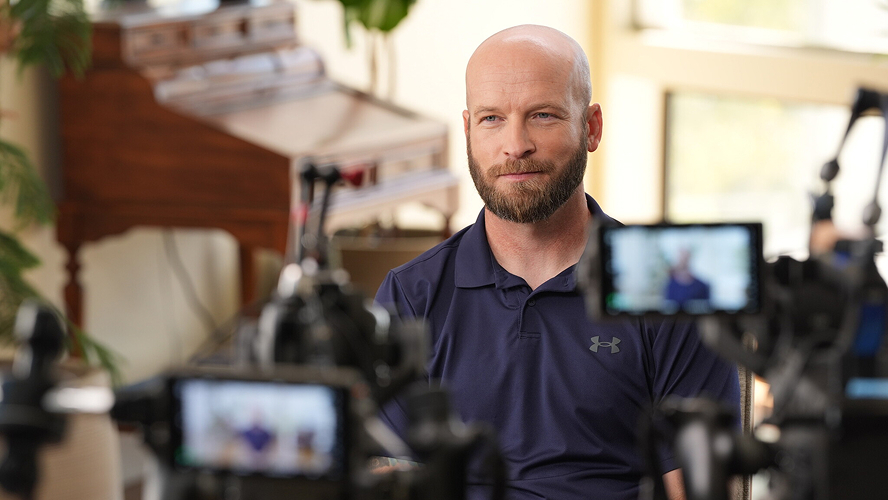
The path that led me to getting my mental health treatment is not something I'm proud of. There was a day that I had lost my temper with another gentleman, and I was charged with a second degree felony, aggravated assault, and in an instant, everything I fought for, everything I believed in, my freedoms were disappearing. I wouldn't be able to own a firearm, I wouldn't be able to vote, and it was an extremely humbling experience for me to, to sit in a courtroom and tell the judge, yes, I did the these things, but I'm not a bad person.
My name is Jarvie. I served in the United States Marine Corps from 2004 to 2008, and my MOS was an 0627 Mobile Ground Forces SATCOM Operator. Fast forward to my first deployment in Fallujah as a young 19-year-old kid, I volunteered for everything, com operators of my MOS, we typically didn't get to spend much time outside the wire, and so I wanted to do some of that Marine stuff.
When I was in TQ, we had walked into the quonset hut, that was the surgical clinic, and it was the most chaotic environment I've ever seen. It really showcased that that war doesn't discern between man, woman, or child. It doesn't care. That stuck with me for a long time. Still does.
Transitioning outta the military was fast. I came back home lost. I was confused. I felt like I didn't fit in. I didn't know anybody, and I was angry. I wasn't with my Marines. I couldn't separate myself from that and be entirely with my family. I was lonely, but I had made myself lonely. I had pulled myself away from whatever family or friends or anybody that wanted to be around me, and then was pissed off that I was alone. It was like this snowball effect. I was depressed. Like I said, I was a very angry man. I was highly volatile. I had a pretty robust drinking problem, and I was on a nowhere path real fast.
I think my most beneficial treatment that I had was just traditional therapy through the VA. I had a therapist that told me one day, she asked, “Jarvie, do you have a dog at home?” I said, I do. She said, “so say you come home from work and the dog had shit on your floor. Is is that a good thing or a bad thing?” I said, “that's a bad thing.” She said, “no, it's not,” and I chuckled and I said, “so you're gonna tell me that it's a good thing?” And she said, “no, it's shit on your floor. Now what are you gonna do about it?”
The biggest win for me overall was learning how to separate emotion and logic. When it comes to the intensive outpatient therapy, it's a long process, so for anybody that, that is considering or is actively participating in any of these therapies, please stick with it. Far too many people, they go home and they don't practice what they've been taught. The idea that not everything has to be taken care of right now, gives you an opportunity to breathe separate from a situation. That emotional and logical distance situationally has saved me countless, countless times. But really, the one thing that has helped me out the most is finding like-minded individuals. Somebody who has experienced what I've experienced, and whether they're on my same path or an adjacent path, I can have those open conversations.
My mental health journey has basically driven me out of society in a sense where I like to be in the wilderness. I like to be in the woods. I like to hunt and fish and hike and ride ATVs and UTVs. I love to be in the marsh, you know, overlooking just cascading ridge lines and valleys of area that needs to be explored.
The biggest thing that makes me look back and say you did it is when I see my kids, they've got a happy childhood. They've got a dad that's present that's there to take care of them. That's my proudest moment, is seeing the family that I've built, the legacy that I'm going to leave. While it's hard to admit that we're broken, find the resources, there are countless resources out there. Connect with that military family again. They're all there with your best interest in mind. That's the first step to becoming well, and it's okay to not be okay.