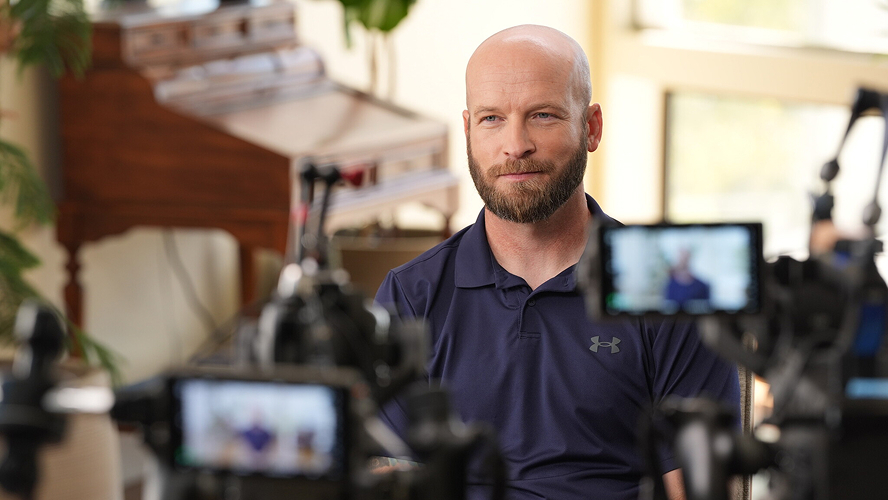
The challenge that surprised me in transitioning was just how shockingly different civilian life was from my military life. It was like being thrown into an Arctic ocean after having hung out at the beach.
I’m Matt. I am a Veteran of the Navy JAG Corps. My designator was 2505 and I was on active duty from 1999 to 2004.
9/11 happens. I'm the Special Assistant US attorney in San Diego and I'm the lawyer for the Naval Criminal Investigative Service in San Diego. I'm 29 years old and at this moment, I'm now expected to have competent advice to give career law enforcement personnel about how to make one of the busiest ports in the world safe. That immediate explosion of stress and responsibility affected my mental health. I had absolutely zero time to experience any of the loss or any of the grief. I simply had to compartmentalize that completely and execute on the mission. And so it wasn't until years later that I realized that I was building a reservoir of depression. I felt lost and I stopped having that really clear north star beacon, ‘This is what I'm here to do.’ When I started to feel real anguish, I was unwilling to reach out to anybody for help. You're gonna end up with some doom loop in your thinking and bad things are gonna happen.
So the symptoms turned into depression, self-loathing, suicidal thoughts. I must really be a worthless person, and I'd probably be better off just being gone. Being a Veteran should have exposed me to a community of people who would've told me, "You do matter. You are worthwhile." So the fact that I was able to make it through at all is what motivates me now to do things like sit down with this interview.
So the different treatments that I received was obviously weekly group sessions for a period of five years. There was also cognitive behavioral therapy, sitting with the psychologist talking out, "How do you feel today?" But the most helpful diagnostic technique we used was kinesthetic therapy. Things as simple as like take a lap, go for a walk, take a break and walk around the building. Adding that into how I managed my stress of my day taught me how to fill in the hole of stress that being a lawyer, being a father, being a Veteran creates.
I learned in therapy that moving your body is part of how your brain offloads the stress that accumulates in your brain. And when we added talk therapy to movement therapy, all of a sudden, a whole lot of things stop weighing so much on me. Mental health is improved by contextualizing it. So recognizing all the things that went into what you were feeling in a moment made it possible to then accept those feelings. Once you can make it mentionable, it becomes manageable.
Saying I'm gonna take time out for a walk, and yeah, that means work isn't gonna get done for the hour I spend walking around a lake, that improves my mental health. It's okay if my hobby doesn't have a direct productive benefit to my skillset as a lawyer. 'Cause I've always been an avid reader, and I've always loved history, and I've always loved travel. And I can justify all three of those in the context of what do I need to do to be a good lawyer.
Resilience is built in community. Bringing in people isn't a confession of weakness. It's a recruiting of resilience. You're never gonna fail a mission you go in with someone else with you. I don't know a single Veteran who has ever failed at anything once they feel like they're not in it alone. But alone, we fail all the time. I believe that we can get through this thing called life if we don't try to do it by ourselves.