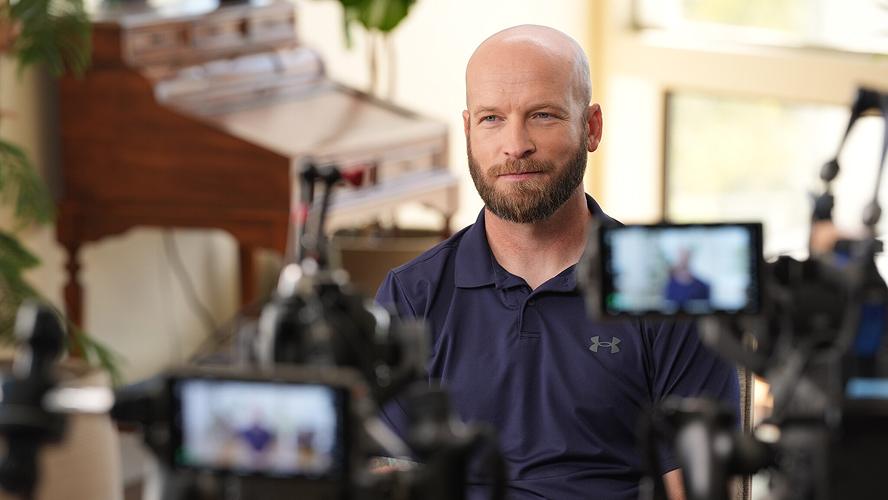
I was deployed to Afghanistan in the Kandahar province and we were on mission and I was shot ten times, five times in the shoulder, four in the hip and then once in the thigh. And from that moment on, I mean, it was really when the mental health issues and journey kind of began.
Hey, my name's Scotty and I was in the United States Army, 11 Bravo, and I served from 2010 to 2015. Going to war in general, you know, you see a lot of things that most humans don't have to see, and it kind of sticks with you, but then you throw in, you know, the trauma of getting shot ten times, and he shot me from probably about 12 feet away, so I saw his face. I know exactly what he looks like. From then on out, every night before I would fall asleep, I would see his face every night. PTSD, depression, anxiety, like that's all very, very real. And it became very real, very quickly for me.
I was realizing that I wasn't the same person. I had to get out of this fight or flight mode if I was going to continue to be the best dad that I could be, the best son that I could be, you know, the best brother that I could be. And I knew immediately that I needed to get help or it was going to consume me. For the longest time I fought it, you know, it was like, ‘Oh, I'm fine. I'm fine. I'm fine.’ And just came to a realization that it was just eating me alive.
I've tried just about everything. Individual therapy is great to a point. Group therapy is great to a point. For me, the one that really, truly helped was exposure therapy. Exposing myself to crowds and exposing myself to situations where I would really start freaking out.
For me, I wanted to be a lifer. Like I wanted to do 20 years. I wanted to make the military my career. So the transition for me was hard because it's just a compound of things that just get thrown onto you about, ‘I need to find a job. I need to still take care of my family, but also I have this injury. How am I gonna do that?’ I went through the times where it was kind of like feel sorry for myself and I can't do this. I don't know how I'm gonna do this. Maybe I should just, you know, give up and just give in and just not do it.’ And really that was when I decided that I was gonna live my life for my best friends who would never have the opportunity because that's what they would want. And that kind of changed everything for me.
I'm the type of guy that wants to understand things. For me, the best therapy was, you know, talking to a therapist and understanding why my body reacts this way, why my mind reacts this way. Why is this happening? Why is this happening? It was a lot of working on myself. And still to this day, with PTSD and depression and anxiety, it's, it's hard to, to live in a moment. It's hard to be here right now.
I went through a lot of times where I would start having panic attacks in crowds, start breathing heavier, your, you know, your palms start getting sweaty, you immediately start going into fight or flight. It's hard to get out of, but it's possible. The thing that really helped me a lot was imagery, you know, closing your eyes, imagining where you are, where you wanna be. Really, man, that has helped me more than anything. And, you know, just breathing and, you know, if you have someone there with you kind of using them as a support as well. For me, I know, if I start feeling a certain way, a lot of times, like, if I like, reach out and touch my girlfriend or I reach out and touch my kids, like, it gives me that, that little bit of grounding.
So I shot archery with US Paralympic program. Archery was kind of an escape for me, you know? For seven seconds right before that arrow releases, nothing else in the world matters, except for you being in that moment and firing that shot at the target. And then COVID shut it down, and I needed to find something, because, you know, when it gets quiet is when the demons knock the loudest, and COVID was very, very quiet. I had a guitar in the corner of my room, and one day I was like, "Man, I'm gonna learn how to play this thing." And then from there, you know, I had this new escape and I had this new sense of purpose and playing the guitar, but I still had feelings and emotions that I didn't know what to do with.
I've been blessed and lucky enough to find music as a tool for therapy. When I'm writing a song, when I'm on stage playing, anytime I have a guitar in my hand, it, it is therapy happening. The most important thing that you can do as a Vet is to just go out and try everything, and who knows? Who knows what could come from it? A lot of times, us Veterans, you know, we're told we can't do something and we're like, "All right, let me show you.” It's important to get that mindset back. It's important to, to feel that again, you know? Your, your quality of life can improve. You just have to do the work to do it.