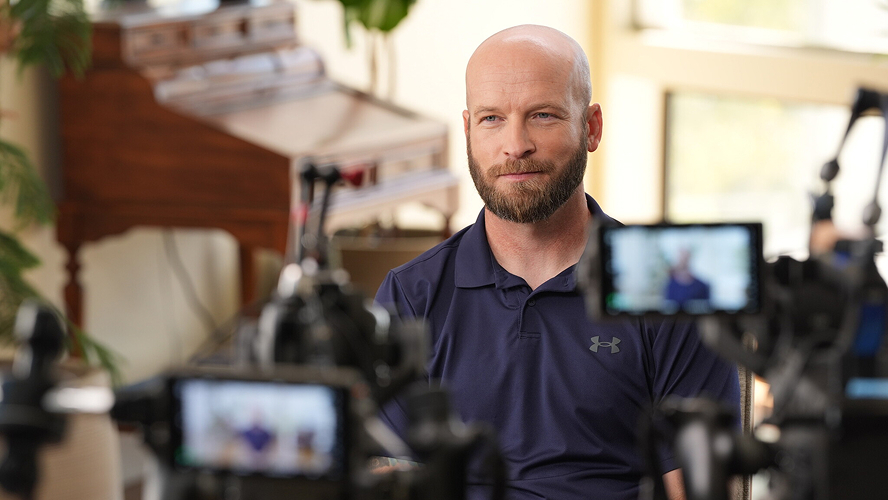
My story I don't think is special. I think there's other Veterans out there have the same story, but they haven't got help. I've been in dark places, but I've gotten help, and life's a lot better.
I'm Joe. I was in the United States Army. I was a 11C Mortarman, in from '91 to '96. What a Mortarman is, basically you're dropping the round down the tube, and it goes out. You've probably seen it on TV. Your head's down by the round when there's an explosion. Every round was a little concussion, very similar to the football players. So when I got out of the Army, I didn't think nothing of it. Started realizing something was wrong. I was having severe memory issues, you know, a lot of sadness. Shouldn't have no depression, I thought, great wife, good boys. I was just still miserable.
I also have trouble sleeping. When you get four hours, five hours of sleep a night for decades, I think that was one of the major reasons I was depressed, was 'cause I was just tired all the time. And then find out from different resources online that, you know, there's some groups out there of other Mortarmen who were dealing with what I had been dealing with. And man, I didn't get blown up. I didn't go to war. You know, I'm noncombat. How do I get a TBI? I learned that, yeah, it's from the weapon system.
Flew out to Colorado to Marcus for an assessment. "Yep, you have it, and we want you to come back for treatment." I say that's the second best thing I ever did in my life. The first one is finding a woman that put up with me, and she's still putting up with me. More relaxed. You know, they really helped me with my sleep, and it's amazing. You go from four hours a night of sleep to even just six, seven. You know, you do that for a week, and your whole outlook on everything changes.
What surprised me the most was how much art therapy we did. When you're doing art, it's something new, something challenging, and it's helping your brain rewire itself around the damaged areas. Then that's why I like fly tying because it's a form of art, and actually fly casting is an art form too. It's hard because, you know, you have to talk. Learn to trust your therapist, and it's something that a lot of Veterans find hard, is trusting other people, especially non-Veterans. The VA's been helping me a lot get better sleep.
Fly fishing and fishing in general, you're outside, and you see a fish in front of you. Nothing else matters. You're in the moment. You know, you ain't worried about the past. Staying in the moment is the key that I try to use. I think a lot of Veterans that are non-combat who are dealing with mental health, they probably got a little bit of, like they feel like they're a fraud. I did, but I got a friend that said something to me that really hit home. He goes, "The worst thing that happened to you is the worst thing that's happened to you. The worst thing that's happened to me is the worst thing that's happened to me. And comparing the two is not fair." If you're struggling with your mental health, it doesn't matter if you've seen combat or not. Go get help, sooner the better. There was 15 years I was struggling with mental health, and I didn't do nothing about it. Everybody I talk to that goes through these programs come out better.