From Hesitancy to Help: Veterans’ First Steps Toward Care
4-minute read
From Hesitancy to Help: Veterans’ First Steps Toward Care
4-minute read
The process of recovering from a mental health challenge begins with the first step toward treatment, but often that’s the hardest step to take. Four Veterans describe what it was like for them and what they learned from the experience, in the hope that other Veterans will follow in their footsteps.
Daniel: Learning to prioritize himself
 Daniel left the U.S. Navy in 2020 after 27 years of service and multiple tours in Iraq. But his time in Iraq didn’t leave him. At home, Daniel remained so anxious and on guard that he couldn’t sleep in his own bed and kept conducting perimeter checks around his house. Yet for a long time he resisted the idea of seeking help.
“I was really reluctant to talk to people about this because it feels like cowardice almost, that I should be able to suck it up,” Daniel says.
It was during telehealth visits with a doctor to alleviate his physical pain that Daniel began dipping his toe into mental health treatment. “Most of the times as it turns out we would talk about my mental state,” Daniel says. “He was a great listener and was able to get me out to talk to other doctors whose specialty was what I was having trouble with.”
Treatment for posttraumatic stress disorder (PTSD) helped alleviate Daniel’s symptoms. He became more relaxed and began sleeping in his own bed again. “This is something I should have looked at much sooner, but it took 8, almost 10 years before I actually went to talk to somebody,” Daniel says. “It’s easy to put your own self at the last of your priorities.”
Valerie: Shedding feelings of blame
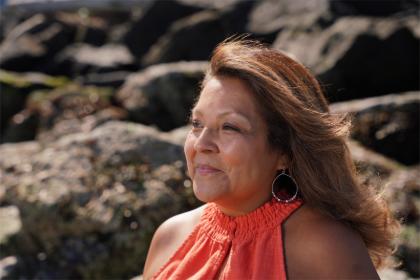
“I joined the Army because I was brought up in a home where military service was just looked at with so much honor,” says Valerie, who enlisted in 1981. Then a fellow service member sexually assaulted her. “It affected my mental health in ways I didn’t even realize at the time,” she says. “A lot of self-blame, wondering, ‘What did I do?’ And in the long run, it would affect me in ways that would just continue to last until I sought help.”
Her first conversations with a therapist about her experience, nearly 40 years after it occurred, were a revelation. “For the first time in my life, I recognized that I was not to blame. That there was hope,” she says. “And he helped me to be able to just take those first steps and move forward.”
Cognitive behavioral therapy and a women’s therapy group have put Valerie on a better path, strengthened her marriage, and helped her find peace, especially when she makes quiet time for herself by the ocean. “You can’t help but come out and see this water and these mountains and feel better about yourself and feel better about your day,” she says.
Glenn: Opening up to find new sources of healing
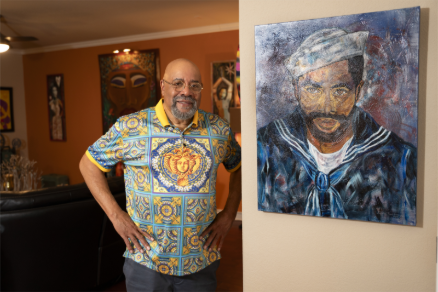
Serving as a quartermaster in Vietnam in the early 1970s, Glenn experienced instances of racism that left him injured and feeling unsafe among his peers. He developed itching and boils all over his upper body from what he later learned was white phosphorus. He had been deliberately exposed to the chemical. When he tried to report what happened, military police took him away rather than allowing him to file his complaint. After being processed out of the Navy, Glenn became depressed, homeless, and suicidal.
Glenn says he had been refusing to go to VA for help until his wife’s persistence finally persuaded him. Diagnosed with schizoaffective disorder and PTSD, he began receiving the care he needed from a VA Psychosocial Rehabilitation and Recovery Center.
"I began slowly to open up, to talk about things and getting some techniques to deal with PTSD, how to mitigate my problems, what I was feeling inside,” Glenn explains. “That's when I began to discover art. I started painting. I found a source of healing.”
Jeffrey: Finding the right fit
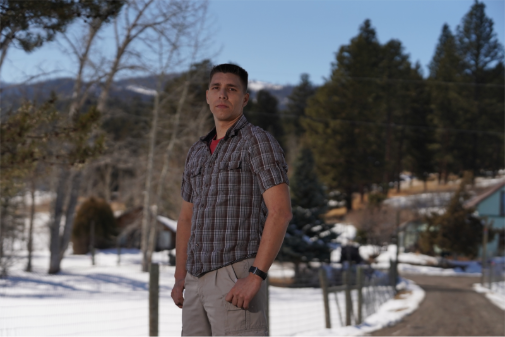
When Jeffrey first decided to seek therapy, he didn’t find the right fit. But he didn’t let that discourage him. He knew he needed help with his challenges, many of them stemming from his service in the Army National Guard in Iraq, where he was injured in mortar and rocket fire attacks.
“The first two people I went to, I tried for two or three sessions and I was just, like, it didn’t feel right, it didn’t feel comfortable, I didn’t feel like this is someone that can hear my story,” Jeffrey explains. He wasn’t afraid to walk out, he says. But, motivated in part by his desire to become a better father to his daughter, he kept looking.
Eventually, he found a therapist who was the right fit for him, and he found treatments that worked for his PTSD, traumatic brain injury, and general anxiety disorder. “I feel finding someone who you're comfortable with is definitely key to healing and progression, and there’s someone out there,” he says. “My advice is [to] go for it. Take that first step.”